
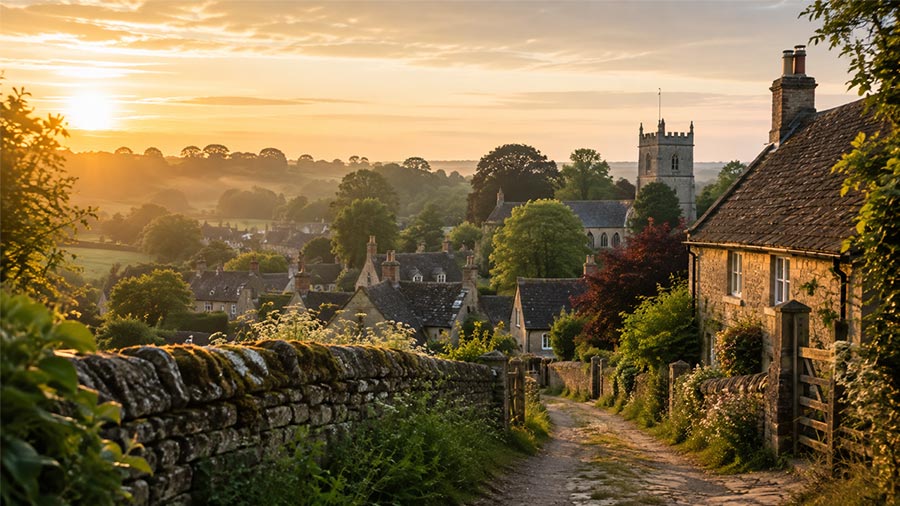
Tucked away in the rolling green countryside of England, South Leigh looks like the definition of a postcard-perfect Oxfordshire village. Honey-colored stone cottages sit behind carefully manicured hedges, and narrow dirt lanes wind lazily past idyllic farmland where sheep graze under the gray British sky. Drivers speeding along the nearby A40 highway might easily dismiss it as just another sleepy hamlet—a quick, pretty blur on the way to Oxford, or at most, a scenic spot to stop for a quick pint.
But beneath this tranquil, almost timeless surface lies a dark, vibrant, and surprisingly pivotal history. South Leigh isn’t just a quiet dot on the map; it is a place where medieval nightmares were painted onto sacred walls, and where a young scholar preached a sermon that would eventually shake the foundation of modern Christianity across the globe.
A Medieval Time Capsule in the Countryside
To understand the ghost of South Leigh’s past, you have to walk to the heart of the village and open the heavy wooden door of the Church of St. James the Great. Stepping inside immediately shifts your reality. The cool, damp air smells of ancient stone and beeswax, and as your eyes adjust to the dim light, the walls seem to come alive with vivid, haunting colors.
Back in the Middle Ages, long before printing presses existed and when standard church services were held entirely in Latin, the average villager couldn’t read a word of scripture. To teach the congregation about salvation, sin, and the consequences of their actions, churches commissioned massive wall paintings. They were designed to shock, awe, and educate.
During the Reformation, many of these “popish” images were whitewashed, buried beneath layers of plaster to hide them from iconoclasts. For centuries, South Leigh’s masterpieces remained hidden in the dark. It wasn’t until a major restoration project in the 1870s, led by the renowned Victorian architect Ewan Christian, that these incredible murals were uncovered and meticulously brought back to life.
The Horrors and Hopes Painted on the Walls
The interior of St. James the Great contains some of the most extraordinary and complete medieval wall paintings surviving in Britain today. Painted using raw mineral pigments mixed with natural binders, these artworks retain a stark, unsettling energy:
- The Doom Painting (15th Century): Positioned dramatically over the chancel arch, this is the crown jewel of the church. It presents a terrifying visual of the Last Judgment. On one side, the righteous ascend to a golden heavenly city. On the other, naked souls are bound in chains, being dragged down by grotesque, monstrous demons directly into the gaping, fiery maw of a giant sea monster—the medieval representation of Hell.
- The Weighing of Souls (15th Century): Located on the south wall, this painting depicts Archangel Michael holding a pair of large balance scales. Inside one pan sits a human soul; on the outside, a sinister, dark demon desperately attempts to pull the scale down to claim another victim for damnation. Nearby, the Virgin Mary places her rosary on the beam to tip the balance back toward mercy.
- Saint Clement (14th Century): Tucked away on the nave wall is a rare surviving mural depicting Saint Clement, the patron saint of mariners. Alongside his figure are surprisingly detailed renderings of medieval ships, offering historians a rare visual glimpse into 14th-century English maritime craft.
Walking past these murals feels less like visiting a standard local parish and more like standing inside an active crime scene of spiritual history.
The Spark That Changed Global Religion
While the medieval paintings give South Leigh its visual punch, a much quieter event in the 18th century cemented the village’s place in world history.
In October 1725, a 22-year-old Oxford scholar climbed into the wooden pulpit of St. James the Great. His name was John Wesley. Freshly ordained as a deacon in the Church of England, Wesley chose this small, isolated parish to deliver the very first sermon of his life.
At the time, nobody in the village could have guessed that this young man would go on to trigger one of the greatest spiritual revivals in history. Disillusioned by the rigidity of the established church, Wesley later took to preaching in open fields, coal mines, and town squares across the UK and America. He went on to found Methodism—a movement that today counts over 80 million followers worldwide.
The quiet wooden pulpit where it all began still stands inside the church, marked by a simple plaque that draws history enthusiasts and pilgrims from every corner of the globe.
Echoes of an Unspoiled Past
What makes South Leigh truly special to modern travelers is how remarkably unchanged it feels. When the modern railway lines and major bypasses were built across Oxfordshire in the 19th and 20th centuries, they completely routed around the village. South Leigh was left in a quiet temporal bubble.
Without massive suburban developments or modern commercial strips, the village has preserved its traditional footprint. The local pub, The Mason Arms, has been serving refreshment to travelers and locals for centuries. Sitting in its garden with a local Oxfordshire ale, listening to the distant chime of the church bells, it is easy to forget what century you are living in.
Planning a Visitor’s Detour
If you are planning an itinerary through the Cotswolds or visiting the historic colleges of Oxford, South Leigh makes for an unforgettable, low-traffic detour:
- Getting There: South Leigh sits roughly 3 miles east of Witney and 10 miles west of Oxford. It is easily accessed by taking a quick turn down the narrow country lanes just off the main A40 road.
- Exploring the Church: The Church of St. James the Great is generally open to respectful visitors during daylight hours. Bring a flashlight or use your phone torch—the ambient lighting inside is kept low to preserve the delicate pigments of the ancient wall paintings.
- Local Etiquette: Because South Leigh is a living, working residential village with narrow single-track lanes, park responsibly near the pub or church and explore the village on foot.
Leave a Reply