

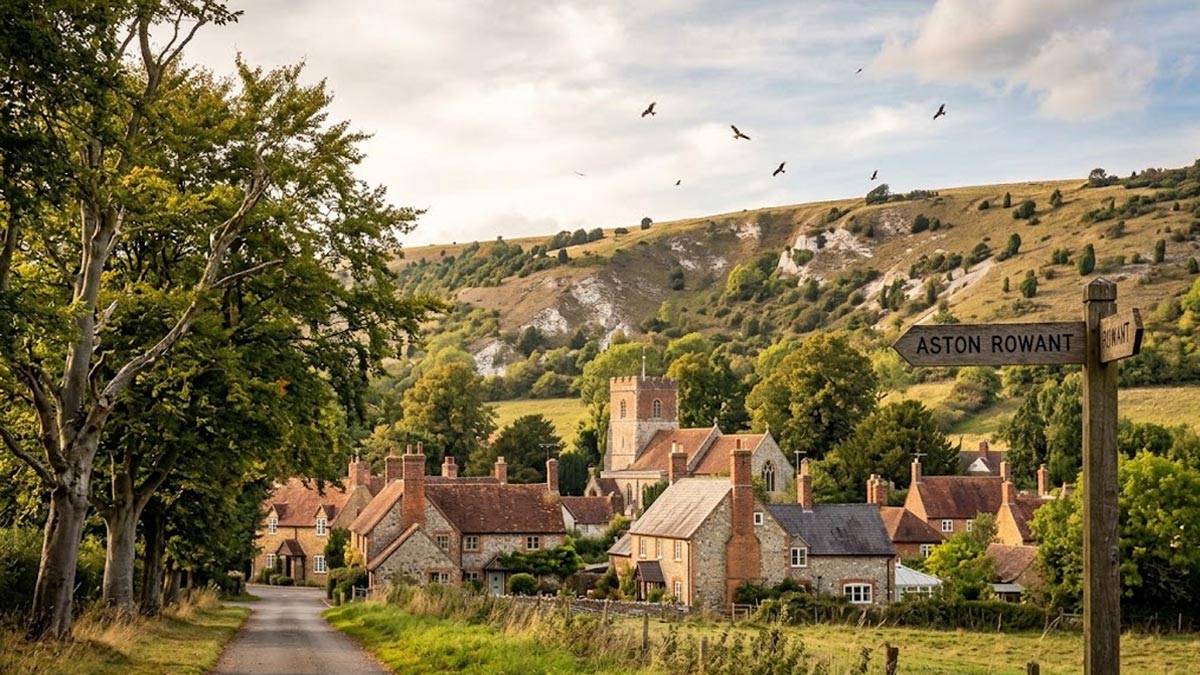
At first glance, Aston Rowant fits the classic blueprint of an idyllic South Oxfordshire hamlet. Honey-colored brick cottages line narrow country lanes, red brick chimneys peak above mature trees, and the faint chime of church bells drifts across quiet fields. Drivers passing near the foot of the Chiltern Hills might easily mistake it for just another picture-perfect stop along the trail.
Look a little closer, and you will find that Aston Rowant breaks the typical Oxfordshire mold. While neighboring villages often trade exclusively on thatched roofs and manicured village greens, Aston Rowant blends dramatic natural topography, rare ecological sanctuaries, and a unique architectural evolution shaped by medieval manors and modern transit.
1. A Gateway to the Chilterns Escarpment
Most Oxfordshire villages in the low-lying vales are defined by flat, sprawling farmland. Aston Rowant sits dramatically at the base of the Chiltern Hills, an Area of Outstanding Natural Beauty (AONB).
The landscape here doesn’t just surround the village—it dominates it. Rising abruptly above the timber-framed homes are steep chalk escarpments, dense beech woodlands, and sweeping chalk downland. This dramatic change in elevation creates microclimates and views rarely matched by other inland settlements in the county.
2. The Aston Rowant National Nature Reserve
Perhaps the biggest distinction is that Aston Rowant shares its name with one of the South East’s most important ecological havens. The nearby Aston Rowant National Nature Reserve (often dubbed “The Top of the World” by locals) offers an experience completely distinct from standard village greens:
- Red Kite Sanctuary: The reserve played a pivotal role in the famous reintroduction of the Red Kite to England in the 1990s. Today, these massive birds of prey circle overhead in numbers unseen elsewhere in the region.
- Rare Chalk Downland Habitat: The reserve protects rare chalk grassland species, including wild orchids, juniper bushes, and the rare Silver-spotted Skipper butterfly.
- The M40 Cutting: In a unique twist of modern infrastructure meeting nature, the M40 motorway carves directly through the chalk ridge near the village. Rather than ruining the area, the deep rock cutting has become an iconic visual landmark and a surprising haven for cliff-nesting wildlife.
3. Architectural Evolution & Lost Manors
Unlike villages built around a single dominating manor house that remains intact today, Aston Rowant’s architectural history is a tapestry of what was and what remains.
The village centers around the historic Church of St. Peter and St. Paul, which features Norman origins, 13th-century additions, and fine medieval brasses. However, the grand Aston House—which once anchored the local gentry—was demolished in the 20th century. In its place, the village evolved into a quiet cluster of historic estate cottages, converted flint barns, and farmsteads. This gives Aston Rowant an authentic, lived-in feel rather than the curated, “museum-like” atmosphere of heavily touristed Cotswold spots.
4. The Ancient Icknield Way Connections
Long before modern highways, Aston Rowant was a key stop along the Icknield Way, widely considered one of the oldest roads in Britain. Trackways used by Neolithic traders, Romans, and medieval drovers all crisscross through the parish. Walking the footpaths around Aston Rowant isn’t just a trek through nature—it’s a walk along trade routes that have been in continuous use for thousands of years.
Visiting Aston Rowant
- Getting There: Situated just off Junction 6 of the M40, roughly 6 miles south of Thame and 16 miles east of Oxford.
- Best For: Walkers, birdwatchers, and history enthusiasts looking to escape the crowds of the main tourist trails.
- What to Bring: Good hiking boots for the steep chalk trails and binoculars for spotting Red Kites along the ridge.
Leave a Reply